
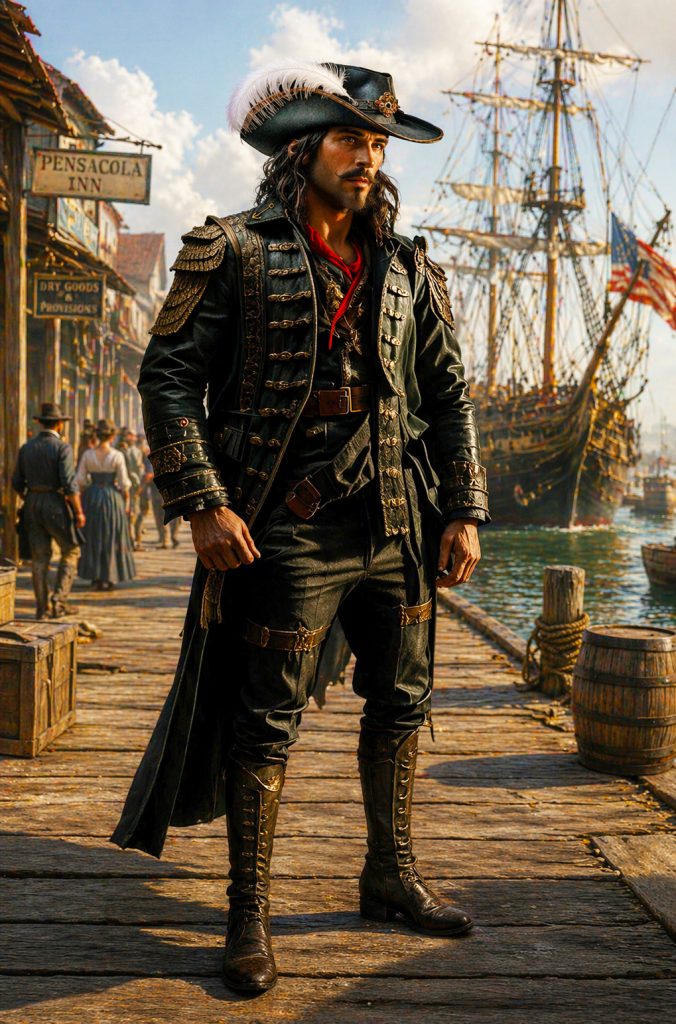
Jean Lafitte
…The Pirate Patriot
In the early 19th century, the Gulf of Mexico was a hotbed of piracy and privateering, and among the most notorious figures was this Pirate King. Can you imagine a pirate so elegant that high society ladies swooned when he entered a ballroom, yet so dangerous that the British Navy offered him a fortune to betray his country. Picture a man who spoke five languages fluently dressed in silk and velvet like French nobility, commanded hundreds of cutthroats who would kill on his orders, this is Jean Lafitte. He was not just a romantic pirate hero, but he also was not just a simple villain. Born around 1778 in the port city of Bayonne, in a family of modest means but considerable education. Lafitte was a Frenchman who found his calling on the high seas. By the early 1800s, Lafitte and his brother Pierre Lafitte were involved in smuggling goods into New Orleans. Their operation was centered around Barataria, a maze of bayous, islands, and waterways south of New Orleans. By 1812, Jean Lafitte was leading the Baratarians, with headquarters on Grand Terre, and the National Park Service says he may have had as many as 1,000 people working for him. The Baratarians sold goods that were often cheaper than legal imports. In New Orleans legend, the Lafitte brothers ran or used a blacksmith shop as a front for smuggling. The idea is that legal business happened in front, while illegal deals happened behind the scenes. That made them popular with some New Orleans buyers but hated by U.S. officials. This fits Lafitte’s image perfectly: respectable face, criminal network underneath.
Pirate or privateer?
A privateer was someone authorized by a government to attack enemy ships. A pirate attacked ships without recognized legal authority. Lafitte often claimed he was a privateer, not a pirate. Some of his men operated under commissions from places like Cartagena, but the United States did not recognize all those commissions as legal. So from the U.S. government’s view, many of Lafitte’s operations looked like piracy. Lafitte is best described as a privateer when it suited him, a smuggler by business, and a pirate in the eyes of his enemies.
The Truth…
Lafitte was more than just a pirate or privateer; he was a creative smuggler, a cunning businessman, a Master of Diplomacy and a war hero surround by legends and mystery moving in the gray area between legal privateering, smuggling, piracy, espionage, and outright criminal trade. His fleet of ships was a formidable force, and he commanded the loyalty of hundreds of men. Despite his illicit activities, Lafitte was well-liked by the local population, who benefited from the goods he smuggled into the region.
The Gentleman Pirate
Lafitte is often portrayed as charming, educated, well-dressed, and polite — a kind of Gulf Coast noble outlaw. This version appears in novels, movies, and local legends. It may have some truth: Jean Lafitte appears to have been intelligent, diplomatic, and good at dealing with powerful people. But the polished “gentleman pirate” image also softens the reality that his network was involved in violence, smuggling, and piracy.
The Battle of New Orleans
In 1814, as the War of 1812 raged on, the British tried to recruit Lafitte and the Baradarans to aid in their campaign against the United States. They offered him money and land, but Lafitte had other plans. He informed the American authorities of the British proposal and offered his services to General Andrew Jackson. Initially skeptical, Jackson eventually accepted Lafitte’s help, recognizing the strategic advantage of his knowledge and resources.
Lafitte and his men played a crucial role in the Battle of New Orleans, providing much-needed artillery and manpower. Their efforts helped secure a decisive victory for the Americans, and Lafitte was hailed as a hero. Afterward, President James Madison pardoned Lafitte and many of his men. Despite his contributions, Lafitte’s piratical ways continued, and he eventually moved his operations to Galveston Island, turning it into a center for smuggling and privateering. His final fate is uncertain. Some accounts say he died around 1821–1823, possibly near the Gulf of Honduras or Yucatán. Legend says Lafitte did not die when most historians think he did. Some stories claim he lived for years under a false name. The mystery of his death is one reason so many legends grew around him.
Jean Lafitte’s legacy is a complex one. He was a pirate, a patriot, and a man of many contradictions. His story is a testament to the turbulent times in which he lived and the indomitable spirit of a man who navigated the treacherous waters of both the Gulf of Mexico and the shifting allegiances of war.